Talgo and Bombardier · Renfe
Renfe S130 (TRAXX S250MSP)

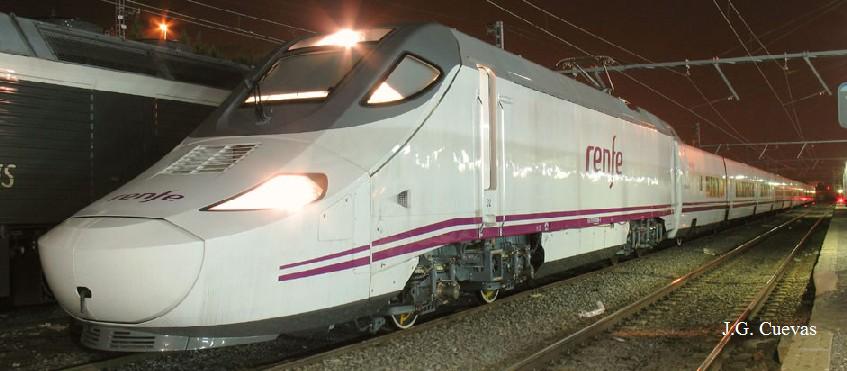
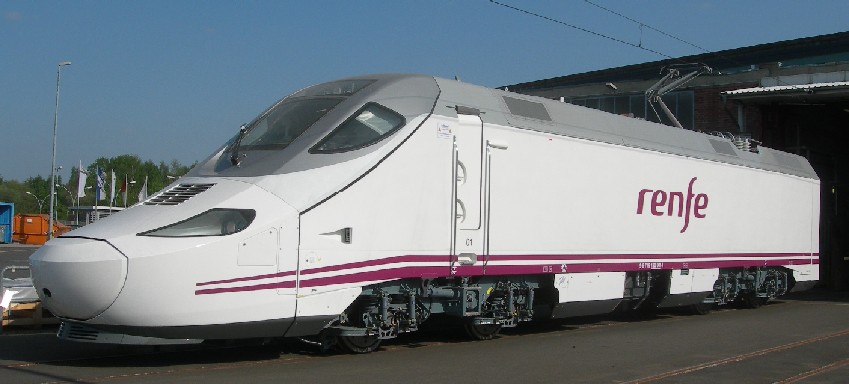
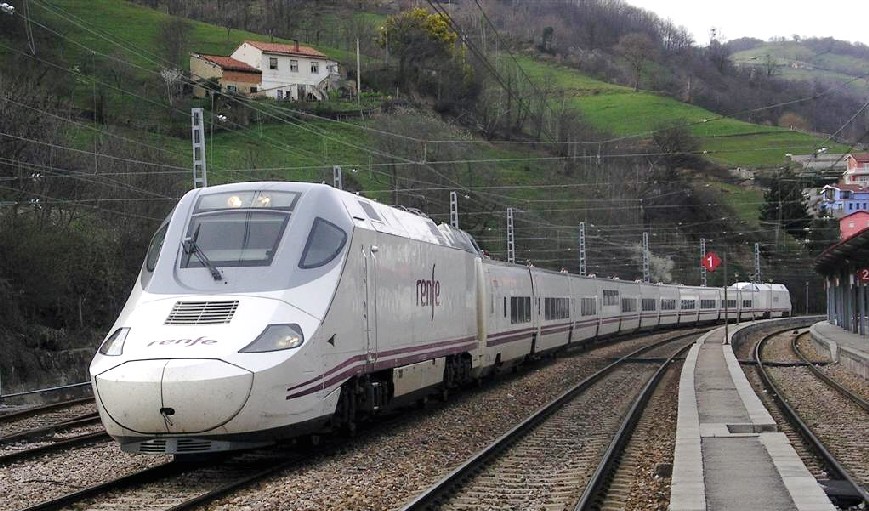
S130
In short
First commercial power head for variable gauge. The well-known Talgo trains for variable gauge have been carrying passengers between Spain (1668 mm) and the rest of Europe (1435 mm) since 1969. Only the towed vehicles went through the gauge conversion plant; a solution for changing the gauge of self-propelled vehicles was difficult to find. Talgo developed a gauge-changeable bogie with traction motors. In 2005 Talgo built the Travca locomotive to demonstrate the feasibility of a gauge-changing locomotive. The Travca has an electrical part from Team with a power of 3.4 MW. The S130 uses the same bogies as the Travca, but with a reduced power of only 2.4 MW. The electrical equipment is supplied by Bombardier. Each of the two IGBT converters drives both motors of a bogie in parallel. From 2012, 15 trains were rebuilt as S730 by replacing coaches 1 and 11 with a 1.8 MW generator car each. This allows them to run on non-electrified branch lines. The generator cars are not on a single axle, but on a bogie.
History
| 04.2004 | First order (44) |
|---|---|
| 10.2005 | Second order (46) |
| 07.2006 | First power head delivered for tests at Wildenrath |
| 09.2006 | First test in Spain |
| 12.2007 | First commercial service |
Technical details
| Designation Renfe | S-130.001 to .090 |
|---|---|
| Designation Bombardier | TRAXX S250MSP |
| Designation Talgo | L-9204 |
| Supply systems | 25 kV AC / 3 kV DC |
| Gauge | 1668 mm / 1435 mm |
| Drive | Hollow shaft, gear ratio 1:3.129 |
| Maximal speed | 250 km/h (25 kV~) / 220 km/h (3 kV=) |
| Maximal traction effort | 110 kN |
| Maximal braking effort | 80 kN |
| Maximal power at wheels | 2.4 MW (25 kV~) / 2 MW (3 kV=) |
| Continuous service | 80 kN at 108 km/h |
| Weight | 72 t |
| Approved for | Spain |
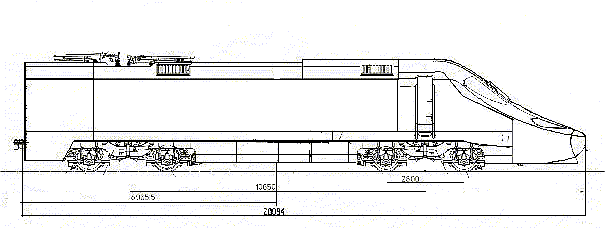
The S130 trains can run at 250 km/h under 25 kV~ on high-speed lines (1435 mm) and at 220 km/h on the conventional Renfe network (1668 mm) under 3 kV=. A train is formed of 11 Talgo cars between two active power heads. The traction effort of a power head must be switched off in the gauge change section. The rear power head therefore pushes the train while the front one passes through the gauge change section; afterwards the front power head pulls the train while the rear one passes. The gauge change section is passed at about 30 km/h. During the gauge change of a power head, its electrical equipment is also reconfigured for the appropriate power supply system.
Links
This page was made in partnership with Railcolor.net, the website about modern locomotive design · all graphics © Simon Wijnakker · last edited 08.05.2007